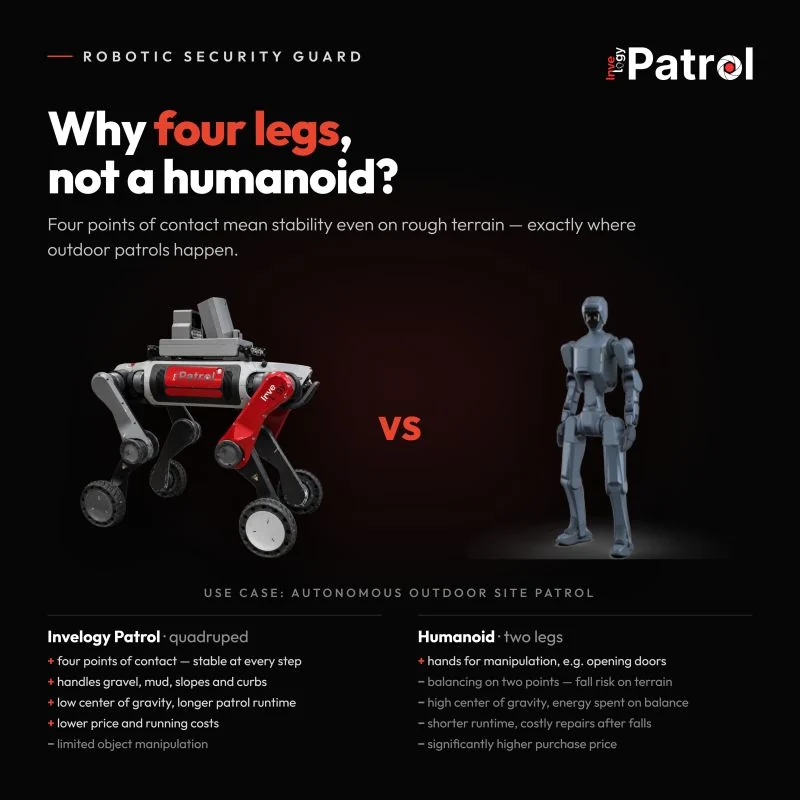
Does a security robot need to look like a person? Not necessarily. When the job involves patrolling outdoor sites, moving across uneven ground and monitoring designated locations, mobility, stability and reliability matter more than a human-like appearance.
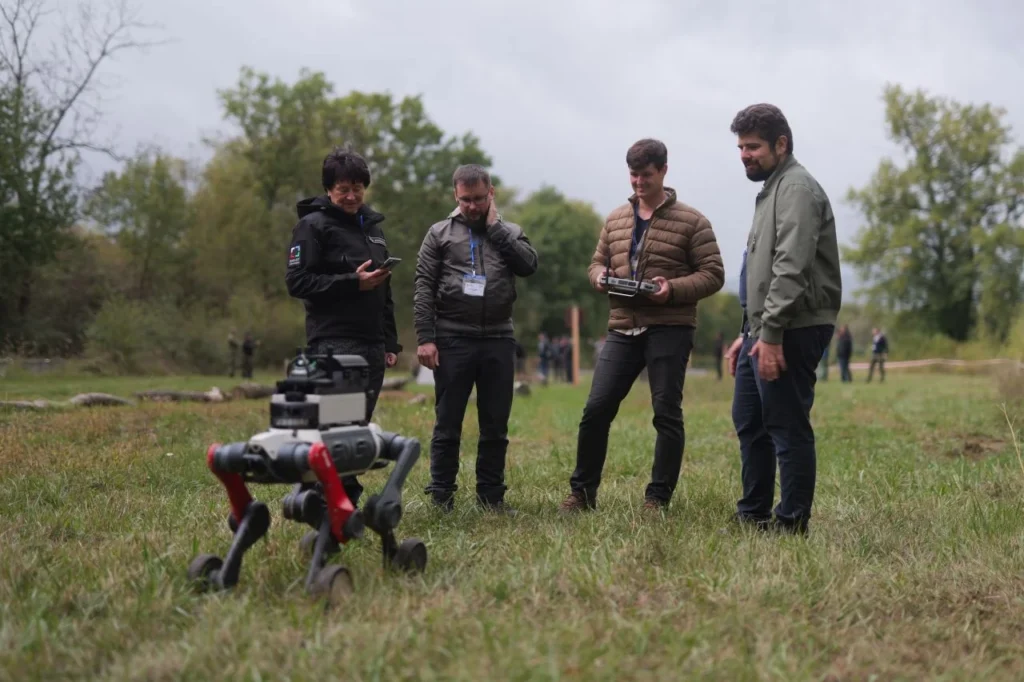
That’s why Invelogy Patrol currently prioritizes quadruped robotic platforms. This isn’t a rejection of humanoid robotics. It’s a decision based on the job we want our robots to perform: autonomous patrols at industrial facilities, logistics hubs and large commercial sites.
Outdoor security starts with real-world terrain
Industrial sites rarely offer perfectly smooth paths from one patrol point to the next. A robot may encounter gravel, grass, curbs, wet surfaces, changes in elevation and uneven ground. That’s why choosing a platform involves more than comparing maximum speeds in a specification sheet.
A four-legged design offers more options for supporting and distributing the robot’s weight than a typical biped. That can make it well suited to varied terrain and reduce some of the challenges involved in balancing on two legs. It does not mean all four feet remain on the ground throughout every step—or that every quadruped can handle every obstacle.
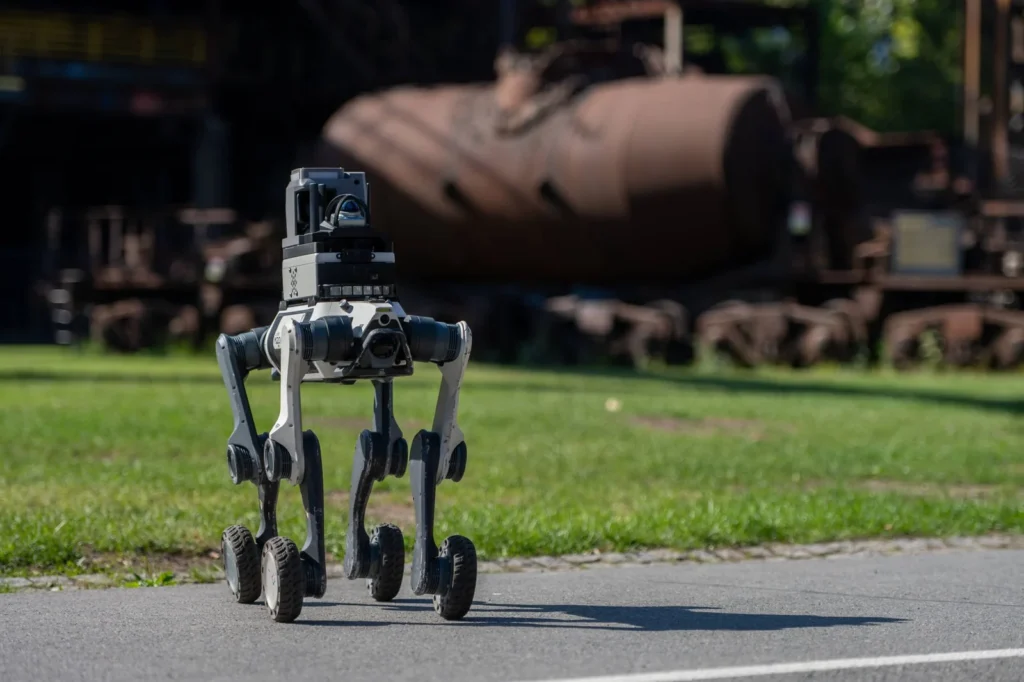
Platform design matters, too. Some quadrupeds combine legs with wheels, allowing efficient rolling on suitable surfaces while retaining leg articulation for more complex terrain. The right configuration still has to be validated under the conditions of the intended deployment.
Four practical reasons we currently favor quadrupeds
1. Mobility beyond smooth pavements. Independently moving legs can help the platform adjust to changing terrain, especially where a conventional wheeled base would be constrained.
2. A useful balance of stability and mobility. Multiple possible contact points and, in many designs, a relatively low center of gravity can be valuable during routine patrols. Actual stability depends on the platform, speed, payload and surface conditions.
3. A design focused on the core security task. For regular patrols, what we need most is reliable navigation, sensors, communication and remote supervision. A human-shaped body and hands are not prerequisites for those functions.
4. Deployment economics. We evaluate the total cost of ownership: acquisition, maintenance, energy use, battery runtime and spare parts—not just the price tag. For the environments we’re targeting today, a quadruped can be a more practical and cost-effective choice. That is not a universal claim about every quadruped or humanoid on the market.
Where humanoids could lead: physical manipulation
Humanoid robots have one particularly compelling advantage: they can be equipped with hands to interact with objects and human-designed infrastructure. Opening doors, operating controls, moving equipment or carrying out certain interventions could eventually make them valuable additions to security operations.
But having hands isn’t the same as being able to perform those tasks safely and reliably in an uncontrolled environment. Dexterity, perception, force control, safety engineering and system integration all matter. Humanoids are promising, but they introduce a different set of engineering and operational challenges.
The use case should determine the platform
Before choosing a robot, we start with the actual job. Is it supposed to inspect the perimeter? Follow a scheduled route? Stream visual and sensor information to a remote operator? Or physically interact with equipment on site?
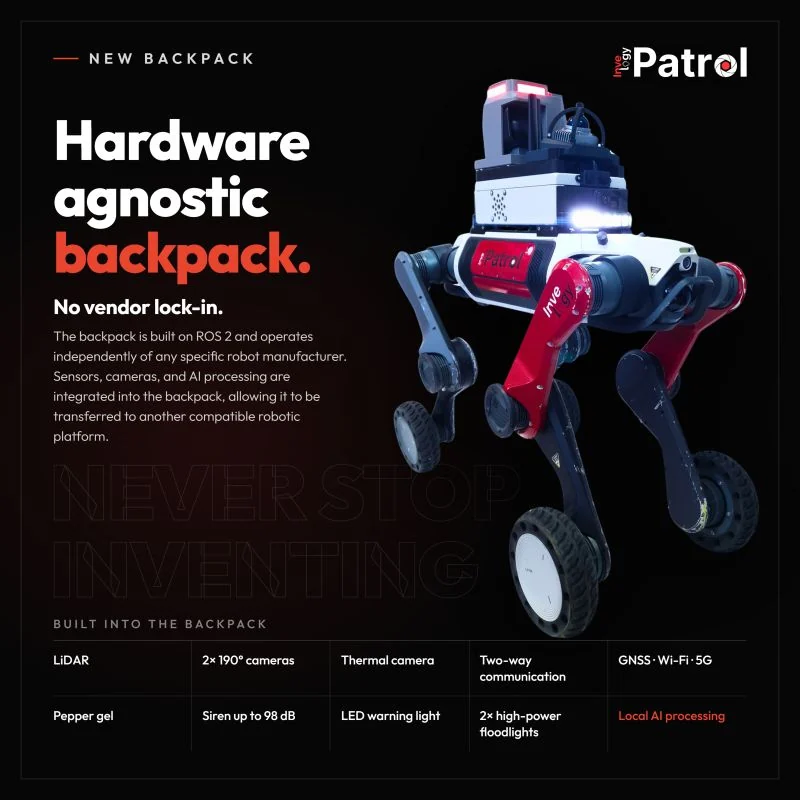
Invelogy Patrol combines robotic mobility, sensing, autonomous navigation, software and human oversight. For security patrols, the priority is a robot that can complete its assigned route and provide useful information when it matters. Its shape is a means to that end, not the objective.
For now, quadrupeds are the better fit for our target environments. As humanoid platforms improve in reliability, autonomous capability and operating economics, we’ll consider adding them to our security ecosystem—particularly for tasks where hands and manipulation make a meaningful difference.
The best robot is the one that solves the problem
There’s no single body shape that’s right for every robotics application. At a large outdoor industrial facility, a quadruped may be the sensible choice. In an environment built around manual controls and physical interaction, a humanoid may eventually be more useful.
At Invelogy, we choose platforms based on operational needs, not which one looks the most futuristic. If you’re exploring autonomous patrols for an industrial or logistics site, we’d be glad to discuss the requirements and potential deployment options.